
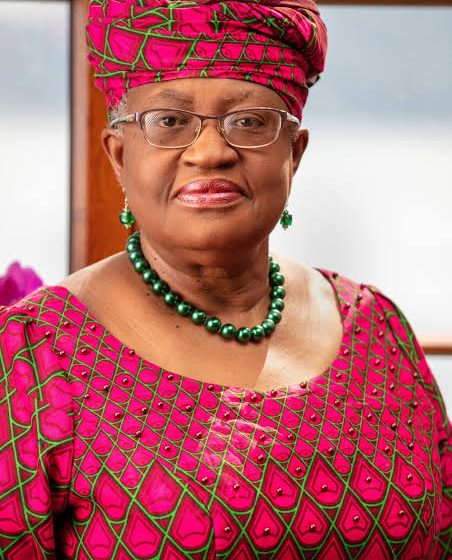

“No amount of Foreign Direct Investment (FDI) can develop Nigeria without private property rights.”
On behalf of all Nigerian and African youths, I pray Madam Ngozi Okonjo-Iweala to respond to the above statement, and so, join in liberating Nigeria and Africa from the colonial template of exploitation and eternal poverty.
When Europeans migrated to occupy America and become Americans, they had a communal system where they all owned the land together, and were all entitled to its harvest. With this entitlement, some became too smart to work less and eat more, and it made food to finish fast. This brought extreme hunger and poverty. So Captain John Smith introduced a private property system by sharing the land for each person to permanently own, work or trade his land as he wished. Introducing this private property system was the first restart moment for America. It drove everyone to work hard on their lands, since they now own the land and everything in it as private property; not for the state, local, regional or federal government. With confidence from private property rights, people took industrial initiatives, studied deeper and got loans, investments and workers to produce more goods and services. In producing more, they had to compete or support others to produce and trade more goods and services; while government focused on regulations, tax and public works. This private property idea later spread to all areas of American life for people to find, develop, protect and trade their private (intellectual, material, service) property. It sowed the seed of liberty that made America the richest, freest and strongest nation on earth, and it has been the main element in the prosperity of most multi-culturally developed nations.
The opposite of private property system is collective property system. This means that most property, mainly lands and mineral resources, are seized and controlled by government. It leads to tight state-driven economies, where government appoints people to control the means of production. And since all products for living and working come from land, common people in collectivist societies cannot use their private lands to get adequate loans, investments, labour and other elements for manifesting their seeds except they are permitted by government.
This collectivist system may be manageable in places with common ethnic or religious tradition, where an internally-made monarchy, dictatorship or religion directs the use of the collective property for products and services that promote their ethnic or religious vision like in Asia. But when a collectivist system is imposed by an external force on various unconsented peoples of dissimilar ethnic and religious backgrounds, it destroys any present or future industrialization efforts, and blocks the focus, liberty or incentive for people to invest and develop their lands.
This collectivist system is what European colonialists imposed as land law on the unconsented communities in Africa for resource exploitation. And while leaving at independence, they vested this law in the postcolonial governments, to continue the colonial project. The continuation of this law after independence means that African communities and individuals are like tenants who lack the liberty to own and use their natural resources to create real wealth in industries, except they are allowed by the same postcolonial governments that were created to bar them from building manufacturing industries that could compete with colonial industries.
Why no foreign direct investment can develop Africa without private property rights
An economically developed society is where people have the liberty, skills and network to make high quality products from manufacturing industries in which crude mineral resources are refined to become high-end products like cars, electronics, medicine, machines, weapons, chemicals, glasses, clothing and other non-perishable products. Apart from needing a lot of capital and years, developing this types of industry to become competitive requires a mix of 5 elements:
- Long-term security of investment from a stable dictatorship or by private property rights from strong public institutions in a society that changes regime every 4 years.
- Highly skilled and motivated workers to run the operations
- Stable and close network of supporting industries for various stages of production
- Viable consumers to steadily and sufficiently buy the products
- A good story (branding) about the culture of the product and society to captivate investors
With these conditions, people get inspired to invest, starting with both local and diaspora members before foreigners, just like in China, Israel and other places. Unfortunately, no sub-Saharan African country has even 3 of the 5 elements.
- Due to the imposed national union on various unconsented groups, they lack stable and fully accepted leadership, nor strong institutions to safeguard private property rights
- Their best workers work to migrate to richer societies who have private property rights or stable dictatorship
- The colonial land-law blocks the local extraction and refining sector except for export to colonialists
- Since locals are barred from owning or using their mineral resources, they mostly lack proper productivity to afford high-end products
- They have no compelling story to captivate the world
So the calls by various experts for Nigerian and African growth through FDI is a mistake, along with all investment hunts and lavish travels by various governments. It is like calling foreigners to build your house, when all your children are running away from it. And even those who try to invest mostly import, repackage, distribute and repair foreign products, while the government-borrowed funds for transport and electricity end up supporting distribution and use of foreign products.
Steps to establishing private property rights in Nigeria
- A non-partisan event like Tour of liberty to sensitize the various communities on the benefits of private property rights based on the new ideology of intercultural liberty
- Intra-district conferences between the communities in various districts in Nigeria to agree on creating private property rights for their members’ economic growth
- Restart National Conference for delegates of the communities to ratify their agreement in a reformed constitution of intercultural liberty
The activation may take 7 years. The communities have to clarify and formally register all their landowners in a land registry, and make 4 copies for their community, local, state and federal government. Then, the communities and individuals whose lands are not currently exploited for foreign exchange will be encouraged to start developing industries from their lands and resources within 2-3 years. This will enable them to stop depending on allocations from the exploitation of the exploited communities in the Niger-Delta before the completion of 6 years. Afterwards, the oil communities can fully retrieve control of their lands.
Just as American constitution, Article 14, Section 4, foreclosed all debt-claims from former slave-owners for the liberation of former slaves, Africa’s land-deprived communities can discuss terms for full retrieval of their lands and resources from the debt-liability from neo-colonial governments and lenders in the Restart National Conference. It is from these resolutions that Africans can expect liberty to create and use their products and services to prosper.
Since Madam Ngozi Okonjo-Iweala has been a major voice for foreign direct investment for African development, she needs to respond to this idea of private property rights and so, join in liberating Nigeria and Africa from neo-colonialism


